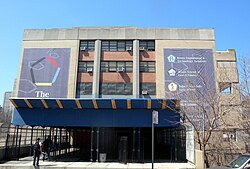
Schools edit John F. Kennedy High School was built in the former riverbed on the western side of Marble Hill, and was opened in September 1972. Beginning in fall 2002, smaller high schools were established within the campus. Due to poor academic performance in the 2000s, as well as a series of violent crimes at the school (including the murder of a student), the New York City Department of Education made a decision in fall 2010 to close the school, phasing out one grade per year until 2014. It closed down in 2014, and six smaller, specialty high schools now occupy its campus: four public, two charter. Four of these schools were founded in 2002, while the other two were established in 2011 after the decision was made to close John F. Kennedy High School. The nearest public elementary school is PS 7 Milton Fein School in Kingsbridge, serving grades K–5. Nearby private schools include Horace Mann School, Riverdale Country School, and Ethical Culture Fieldston School. Nearby parochial scho...
Colonization edit Marble Hill has been occupied since the Dutch colonial period. On August 18, 1646, Governor Willem Kieft, the Dutch Director of New Netherland, signed a land grant to Mattius Jansen van Keulan and Huyck Aertsen which included the whole of the present community. Johannes Verveelen petitioned the Harlem authorities to move his ferry from what is now the East River and 125th Street to Spuyten Duyvil Creek because the creek was shallow enough to wade across, thus providing a means of evading the toll. The ferry charter was granted in 1667. Many settlers circumvented the toll for the ferry by crossing the creek from northern Marble Hill to modern Kingsbridge, Bronx, a point where it was feasible to wade or swim through the waters. In 1669 Verveelen transplanted his ferry to the northern tip of Marble Hill, at today's Broadway and West 231st Street. Bridges edit Two bridges connected Marble Hill with the mainland: the King's Bridge and the Dyckman Free Bridge. In 1...
Marble Hill is the northernmost neighborhood in the New York City borough of Manhattan. It is one of the few areas within the Manhattan borough that is not on Manhattan island. Marble Hill was occupied as a Dutch colonial settlement in 1646, and gained its current name in 1891 because of marble deposits underneath the neighborhood. Politically a part of New York County, Marble Hill became an island in the Harlem River when it was separated from the island of Manhattan by the construction of the Harlem Ship Canal in 1895. In 1914, the Harlem River was filled in on the north side of Marble Hill, connecting it to the North American mainland and the Bronx. The boundaries of the neighborhood are approximately between Terrace View Avenue and Johnson Avenue to the west, between 228th Street and 230th Street to the north, and cutting through the Marble Hill Houses and River Plaza Shopping Center to the east. Because of this change in topography, Marble Hill is often associated with the Bronx...


Comments
Post a Comment